
 Last Updated on
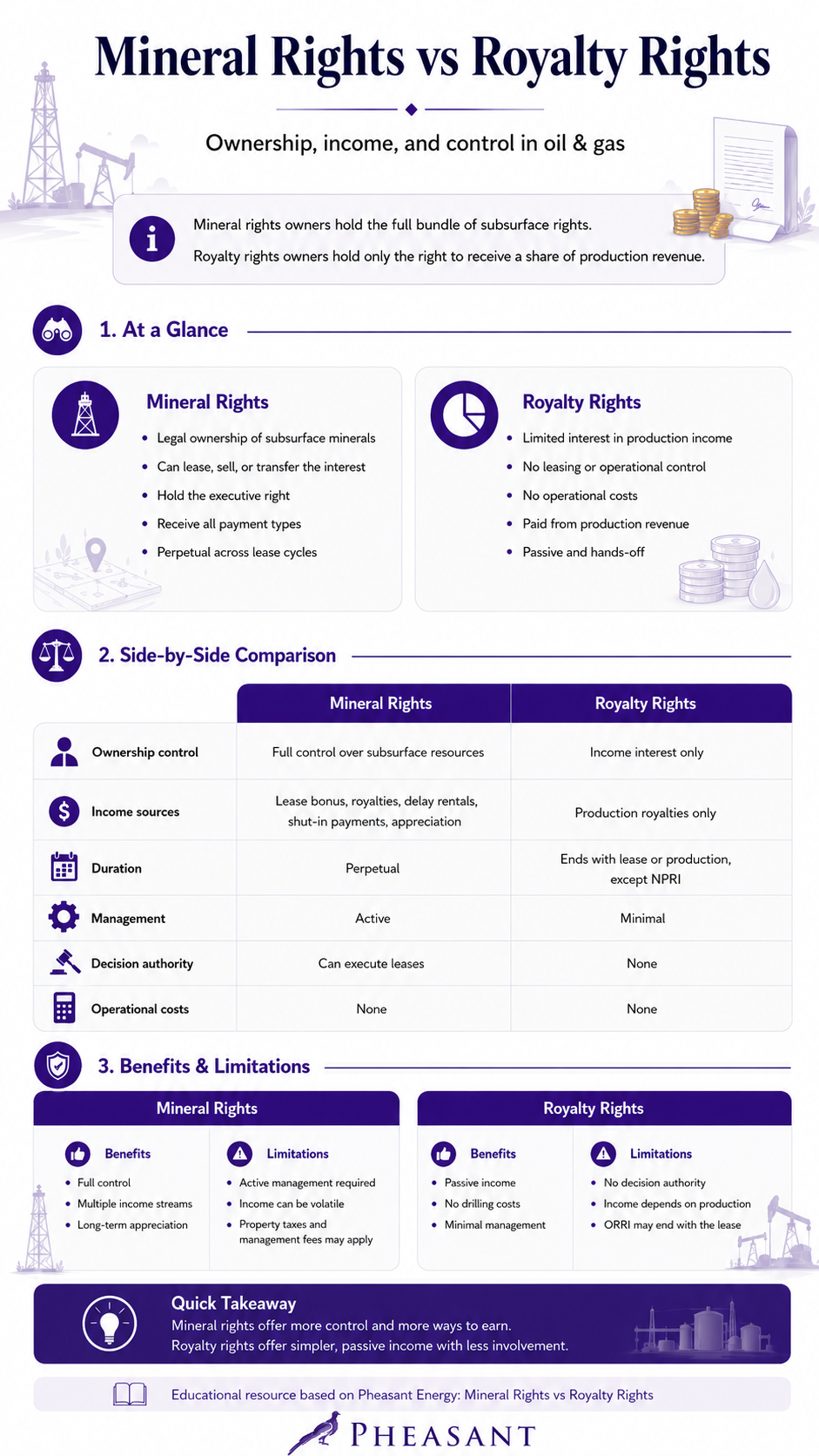
 Mineral rights differ from royalty rights in ownership scope and control: mineral rights owners hold the full bundle of subsurface property rights — including the right to lease, negotiate, and receive every payment type — whereas royalty rights owners hold only the right to receive a production income percentage.
The U.S. crude oil production averaged 13.2 million barrels per day (b/d) in 2024 — a record high — with approximately 87% of that output coming from privately held mineral estates; the Department of the Interior disbursed $16.45 billion in federal energy revenues in FY2024 alone (EIA, 2025; DOI, 2024).
Key Takeaways:
- Mineral rights include the executive right, lease bonuses, and royalties; royalty rights deliver production income only.
- 78% of U.S. oil and gas wells produce 15 BOE/d or less (EIA, 2024), so most royalty interests generate modest income.
- Royalty income qualifies for a 15% depletion deduction under 26 U.S.C. Section 613A(c); an NPRI survives lease expirations while an ORRI does not.
This article covers mineral rights and royalty rights definitions, the full comparison between them, royalty interest types (Ownership Interest, NPRI, and ORRI), working interest, the leasing process, benefits and limitations, the bundle of rights framework, tax considerations, how to evaluate and choose, and the distinction between mineral deeds and royalty deeds.
What Are Mineral Rights?
Mineral rights are the legal ownership interest in subsurface resources — including oil, gas, coal, and other minerals — beneath a parcel of land, giving the owner full authority to extract, lease, and profit from those resources.
Unlike most countries — where subsurface resources belong to the state — the U.S. allows fee simple private ownership of subsurface minerals. Mineral rights can be severed from surface rights, creating two separate estates: the surface estate and the mineral estate. In mineral-dominant states such as Texas and Oklahoma, the mineral estate is the dominant estate — a status the Texas Supreme Court affirmed in Moser vs. U.S. Steel Corp. (1984). Mineral rights are perpetual. You can divide them through inheritance, conveyance, or reservation, resulting in co-tenants each holding an independent right to explore, develop, and lease the minerals.
What Are Royalty Rights in Oil and Gas?
Royalty rights (also called a royalty interest) are a limited ownership interest in subsurface resources that entitles the holder to receive a percentage of production revenue without bearing any operational costs or participating in leasing decisions.
No lease bonuses, no delay rentals, no shut-in payments — those payment types accrue to mineral rights owners through the leasing process, not to royalty rights owners. Distributions are typically made monthly or quarterly based on production schedules and market conditions. Royalty payments represent a percentage of production revenue, though post-production cost deductions — including transportation and processing — are sometimes applied and can reduce the net royalty payment.
What Is the Difference Between Mineral Rights and Royalty Rights?
Mineral rights differ from royalty rights in decision-making authority and income scope: mineral rights owners control subsurface resources and can lease or sell them, while royalty rights owners earn production income without controlling operations or assuming costs.
Here’s how the two compare across four core dimensions. Mineral rights owners hold the executive right; royalty rights owners hold none. Mineral rights generate lease bonuses, royalties, delay rentals, shut-in payments, and appreciation; royalty rights generate only production royalties. Mineral rights are perpetual across lease cycles, whereas royalty rights (except NPRI) terminate when the lease expires. And where mineral rights demand active management, royalty rights require minimal involvement.
A mineral rights owner who leases to an oil company receives both an upfront lease bonus and an ongoing royalty percentage. A royalty rights owner in the same scenario receives only the production income — no leasing involvement and no bonus.
| Feature | Mineral Rights | Royalty Rights |
|---|---|---|
| Ownership control | Full control over subsurface resources | No control — income interest only |
| Income sources | Lease bonus, royalties, delay rentals, shut-in payments, appreciation | Production royalties only |
| Duration | Perpetual — survives lease expirations | Terminates with lease or production, except NPRI |
| Management burden | Active — lease negotiations, legal, tax | Passive — minimal involvement |
| Costs borne | None — no operational costs | None — no operational costs |
| Decision authority | Full executive right — can execute leases | None — no authority over leasing or operations |
| Transferability | Fully transferable by deed, will, or conveyance | Transferable, but income-only interest passes |
Royalty rights are structurally limited in long-term value relative to mineral rights: because they provide no lease bonus, no executive control, and — for ORRI — expire with the lease, they yield less total income per mineral acre than full mineral rights, while requiring zero management involvement.
What Types of Royalty Interest Exist in Oil and Gas?
Three primary types of royalty interest exist in oil and gas: Ownership Interest, Non-Participating Royalty Interest (NPRI), and Overriding Royalty Interest (ORRI).
The type you hold — or acquire — determines both the long-term value and the risk exposure of the interest.
What Is Ownership Interest (Royalty)?
Ownership Interest is the most common type of royalty interest: it is the royalty component embedded in a full mineral estate, belonging to the property owner who also holds the subsurface rights.
When you own the mineral estate and execute an oil and gas lease, you reserve a royalty percentage on production — that reservation is the ownership interest. Royalty percentages typically range from 12.5% (one-eighth, the common floor) to 25% of production value. Four variables determine the rate you can negotiate: market competition in the area, perceived geological risk, current oil and gas prices, and overall well economics.
What Is a Non-Participating Royalty Interest (NPRI)?
A Non-Participating Royalty Interest (NPRI) is a royalty interest carved from the mineral estate and held separately from the mineral interest itself, created by conveyance or reservation before the oil and gas lease is executed.
As an NPRI holder, you receive royalties only — no lease bonus, no delay rental payments, and no participation in lease negotiations. One feature distinguishes it sharply from the Overriding Royalty Interest: an NPRI is perpetual, surviving lease expirations across multiple lease cycles. If a mineral owner leases at a 20% royalty rate and has previously reserved a 3% NPRI, the NPRI holder receives 3% and the mineral owner retains 17% of the royalty income. Mineral owners sometimes sell NPRIs to raise immediate capital — for medical expenses or property improvements — and the purchaser then receives that percentage-based production income for the life of the mineral estate.
What Is an Overriding Royalty Interest (ORRI)?
An Overriding Royalty Interest (ORRI) is a royalty interest carved from the working interest’s (lessee’s) share of production — not from the mineral owner’s share — and expires when that lease expires or production permanently ceases.
No executive right, no bonus entitlement, no rental right. ORRIs are historically granted to geologists, landmen, and attorneys as compensation for services in facilitating a lease. A landman negotiates an 18.75% lease, assigns it to an operator, and reserves a 1.25% ORRI for himself; the operator then pays both the 18.75% royalty to the mineral owner and the 1.25% ORRI to the landman from production revenues. A Term Royalty Interest follows a similar structure but is specifically time-limited to a defined number of years — if no well is drilled or production stops before the term expires, the interest reverts to the grantor.
An ORRI is the most vulnerable royalty interest in a lease termination scenario: because it is carved from the working interest share and expires with the lease, an ORRI holder loses all income the moment the lease lapses, while an NPRI holder’s interest survives and attaches to any future lease on the same mineral estate.
What Is Working Interest in Oil and Gas?
Working interest (WI) is the leasehold interest held by the company or individual that drills and operates an oil or gas well, granting the right to explore, develop, and produce minerals while requiring the owner to bear 100% of all exploration, drilling, and production costs — if the royalty rate is 25%, the WI owner receives 75% of production revenue before deducting operating expenses.
Multiple oil pump jacks operating across a field, illustrating working interest and active oil and gas production.
Working interest expires when the oil and gas lease expires or when production permanently ceases. It can be fractional, with the operator serving as managing WI owner under a Joint Operating Agreement (JOA); qualified investors often participate through non-operating working interests rather than as operators.
Consider how complex the layering can get. John executes a lease at a 25% royalty and a $1,000/NMA bonus. Landman Bill assigns the lease to POPS Oil Co. while retaining a 10% working interest and a 1% ORRI. POPS’s CEO separately carves out a 4% ORRI — leaving POPS bearing full drilling costs while paying royalties to three parties simultaneously.
Wells typically take years to pay out, and a WI operator may never recover the full initial investment. That risk does not apply to royalty interest holders. Working interest ownership carries significantly higher risk than royalty interest ownership, because the WI owner bears all operational costs while sharing production revenue with royalty holders.
How Does the Oil and Gas Leasing Process Work?
The oil and gas lease is the legal instrument that simultaneously creates the working interest for the operator and the royalty interest for the mineral owner — and it works in three stages: the mineral owner (lessor) executes a lease agreement with an operator (lessee), the lessee pays an upfront lease bonus and commences exploration, and the lease continues into a secondary term as long as production occurs in paying quantities.
A person signing a legal document with a pen, representing the execution of an oil and gas lease agreement.
A lease bonus is an upfront, lump-sum payment made at signing, before any production occurs. Beyond the bonus, mineral rights owners may also receive delay rental payments — paid periodically to prevent lease expiration before drilling begins — and shut-in payments when a completed well is temporarily not producing. Royalty rights owners receive none of these. Only production royalties. The royalty percentage negotiated in the lease determines what share of production revenue the mineral owner retains from each well.
What Are the Benefits and Limitations of Each Ownership Type?
Mineral rights have 4 primary benefits and 3 primary limitations. Their main benefit is multi-stream income control; their main limitation is active management demand. Royalty rights have 4 primary benefits and 3 primary limitations. Their main benefit is passive income with zero operational exposure; their main limitation is total absence of control.
Mineral Rights — Benefits:
- Full executive control: you negotiate lease terms, select operators, and receive all payment types including lease bonuses, delay rentals, and shut-in payments
- Multiple income streams: researchers estimated approximately $31 billion in total private oil and gas royalties were paid in 12 major producing states in 2012 alone (Choices Magazine), illustrating the scale available to mineral rights holders with productive acreage
- Perpetual duration: repeated lease cycles are available as prior leases expire — your asset does not disappear when a well stops producing
- Long-term appreciation: commodity price increases or new well development on your acreage support generational wealth potential
Mineral Rights — Limitations:
- Active management required: lease negotiation, legal due diligence, and tax compliance consume time and professional fees
- Income volatility: market conditions directly affect both lease value and royalty income across oil and gas price cycles
- Ongoing costs: property taxes and management fees apply regardless of whether production is occurring
Royalty Rights — Benefits:
- Passive income: no drilling costs, no production expenses, and no operational liability whatsoever
- No cost overrun exposure: working interest cost burdens do not apply to royalty rights holders
- Predictable revenue: production-based distributions are made monthly or quarterly
- Minimal management burden: royalty rights are largely hands-off once acquired
Royalty Rights — Limitations:
- No decision authority: you have no control over leasing decisions, operator selection, or field operations
- Production-dependent income: 78% of U.S. oil and gas wells produce 15 BOE/d or less (EIA, 2024), meaning most royalty interests generate modest income
- Income cessation risk: income stops when the associated lease expires (for ORRI) or when production permanently ceases
Working Interest — For Contrast:
- Highest risk: working interest owners bear 100% of exploration, drilling, and production costs
- Highest potential reward: WI owners receive all remaining revenue after royalties — but only after recovering substantial upfront costs
- Expires with lease: unlike mineral rights (perpetual) or NPRI (perpetual), working interest terminates when the lease expires or production ceases
What Is the “Bundle of Rights” in Mineral Ownership?
Every interest type in mineral ownership represents the same collection of separable rights — with one or more components removed at each step. That’s the bundle of sticks model, and it explains exactly which rights diminish when you sell, sever, or carve out an interest.
A full mineral interest holds every stick in the bundle: the executive right, the lease bonus right, the delay rental right, the royalty right, and the right to explore and develop.
Strip out the executive right and you have a Non-Executive Mineral Interest (NEMI) — the bonus and royalty rights remain. Remove the executive right and the bonus right, and what’s left is a Non-Participating Mineral Interest (NPMI): royalties only. Go one step further by also removing the rental right and carving the interest away from the mineral estate entirely, and you have an NPRI — perpetual production royalties that survive lease cycles, but nothing else. An Overriding Royalty Interest (ORRI) sits at the far end: carved from the working interest share after lease execution, it is the most temporary interest of all, expiring when the lease expires.
A Term Mineral Interest holds all rights but only for a defined period, reverting to the grantor upon expiration. Texas adds one more instrument to the mix: the Mineral Classified Interest (Relinquishment Act Lease or RAL), created under the Texas Relinquishment Act of 1919, splits bonuses, rentals, and royalties equally with the surface owner — all leases reviewed by the Texas General Land Office (GLO).
Put simply: a full mineral interest is the most valuable because it is perpetual and generates multiple income streams. An NPRI is the most durable royalty-only interest because it is also perpetual. An ORRI carries the highest risk of all royalty interests because it expires with the lease.
If a landowner grants a 10-year term mineral and royalty interest to a church while retaining executive rights, and the church receives a lease bonus under the agreement, the church’s interest is classified as a NEMI — not an NPMI — because the bonus entitlement remains in the bundle.
What Are the Tax Considerations for Mineral and Royalty Income?
Which sticks you hold in the bundle determines not only what you earn, but how that income is taxed — and the IRS applies a specific framework to oil and gas royalty income. The standard depletion rate for oil and gas royalty income under U.S. federal law is 15% of gross income from the property — confirmed at the statutory level by 26 U.S.C. Section 613A(c), which grants independent producers and royalty owners of domestic oil and gas a percentage depletion deduction subject to a ceiling of 65% of the taxpayer’s taxable income from all sources.
Royalty income from oil and gas production qualifies as passive income for tax purposes under IRS rules, and the 15% depletion allowance makes it more tax-efficient than many other passive income types. State-level obligations add another layer.
Texas imposes a crude oil production tax of 4.6% of market value, borne ratably by all parties including royalty interest owners. North Dakota imposes an oil gross production tax of 5% of gross well value, with royalty interests from state, federal, municipal, and American Indian holdings excluded. Consult a tax professional for your specific interest type and state of production.
How Do You Evaluate and Choose Between Mineral Rights and Royalty Rights?
Selecting between mineral rights and royalty rights depends on your financial goals, your risk tolerance, and your desired level of management involvement.
Mineral rights suit investors with a long-term strategy, confidence in geological and production potential, and interest in maximizing total income including bonuses and appreciation. Royalty rights suit investors who prefer passive income with no management burden and lower risk tolerance. Selling either type makes sense when you have immediate capital needs or want to eliminate management responsibilities.
For investors evaluating royalty opportunities, the U.S. Geological Survey (USGS) provides data on geological quality, production history, and operator performance. When assessing any royalty acquisition, apply these 5 evaluation criteria:
- Production potential — review geological data and the operator’s production history for nearby wells in the same formation
- Lease terms — assess the royalty percentage, lease duration, and whether post-production cost deductions apply
- Operator reputation — evaluate the operator’s financial stability, technical experience, and track record of paying royalties on schedule
- Market conditions — account for current and projected oil and gas price trends, which directly affect income from any royalty interest
- Diversification — consider spreading exposure across multiple wells or basins to reduce dependence on a single production zone
What Are Mineral Deeds and Royalty Deeds?
A mineral deed differs from a royalty deed in ownership scope: a mineral deed transfers full subsurface ownership rights — including the executive right, the right to receive lease bonuses, and all other mineral estate interests — while a royalty deed transfers only the right to receive production income.
A conveyance transfers property or an interest from a grantor to a grantee; unless rights are expressly reserved in the conveyance document, all right, title, and interest passes to the grantee. Receive a royalty deed, and you are not a mineral rights owner — you hold no executive right, no bonus right, and no authority over leasing decisions. Net mineral acres (NMA) represent the proportional ownership unit of the subsurface mineral estate. Net royalty acres (NRA) represent a unit of production revenue share, calculated differently from NMA.
Once mineral rights are severed from the surface estate, the surface owner retains no claim to any minerals or royalties — a Surface Use Agreement can be negotiated separately to define extraction access rights. Understanding whether a transaction involves a mineral deed or a royalty deed is the first question any buyer or seller should resolve.
How Does Pheasant Energy Help Mineral Rights and Royalty Rights Holders?
Pheasant Energy is most commonly engaged in mineral rights acquisition, royalty interest evaluation, and leasing consultation across multiple U.S. oil and gas basins.
The U.S. had 918,481 producing oil and natural gas wells in 2024 (EIA), each representing a potential royalty income stream for the mineral rights or royalty rights holder attached to that well.
Through its MineralCentric division, Pheasant Energy evaluates mineral and royalty interests and facilitates transactions for landowners seeking to sell or monetize their acreage. Pheasant Energy buys and sells mineral rights, advises on oil and gas lease terms, and connects investors with royalty interest opportunities across producing basins. For landowners evaluating a lease offer or investors assessing a royalty acquisition, Pheasant Energy’s expertise in mineral rights and royalty rights structures provides the guidance needed to make an informed decision.
Frequently Asked Questions
Can You Own Both Mineral Rights and Royalty Rights at the Same Time?
Yes, you can own both mineral rights and royalty rights simultaneously, because a mineral rights owner automatically holds the royalty component (the ownership interest) as part of the full mineral estate and can separately acquire an NPRI carved from another party’s mineral estate.
How Are Royalty Payments Calculated?
Royalty payments are calculated in 2 stages: first, the Net Royalty Interest (NRI) is determined using the formula royalty percentage × (NMA / net leasehold acres), and then that NRI is applied to gross production revenue to produce the monthly royalty check. Example: a 20% royalty on 10 NMA in a 1,280-acre drilling unit = 20% × (10/1,280) ≈ 0.156% of gross production revenue.
What Happens to Royalty Rights If Production Permanently Ceases?
Without active production, each interest type responds differently to permanent well abandonment: an ORRI expires immediately when the lease expires or production ceases. An NPRI survives because it is perpetual, remaining attached to the mineral estate across future lease cycles. A full mineral interest also survives — the mineral rights owner retains the right to execute a new lease. Only the working interest expires with the lease alongside the ORRI.
Are Royalty Rights a Good Investment?
Royalty rights have 3 primary advantages and 3 primary limitations. Their main advantage is passive income with no drilling costs or operational liability; their main limitation is total absence of control over production decisions. The 15% depletion allowance under IRC Section 613A makes royalty income more tax-efficient than most comparable passive income assets. Income depends entirely on production levels and ceases when the lease expires (for ORRI) or production stops — royalty rights are best suited for investors prioritizing income predictability and portfolio diversification over long-term equity appreciation.